
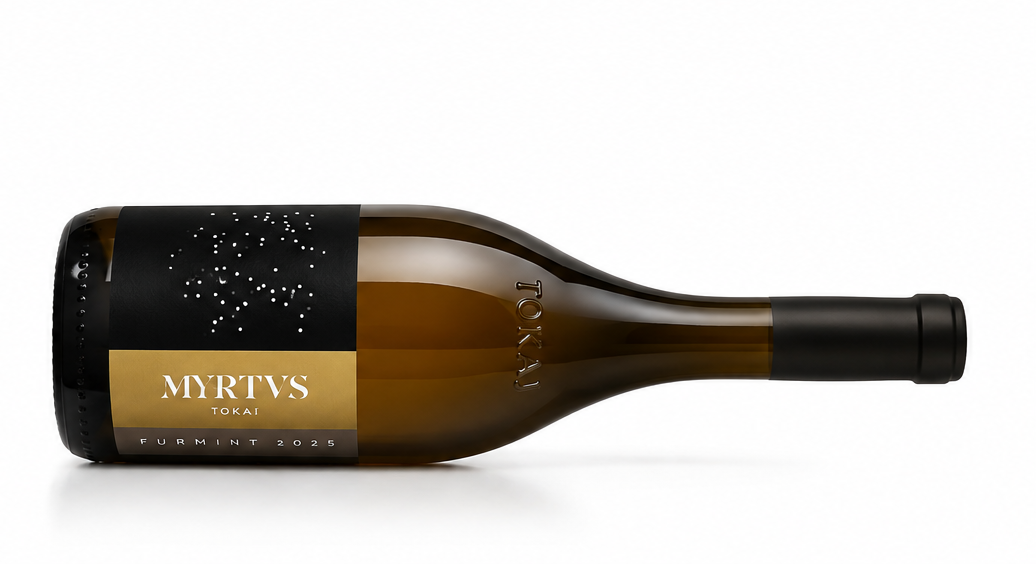
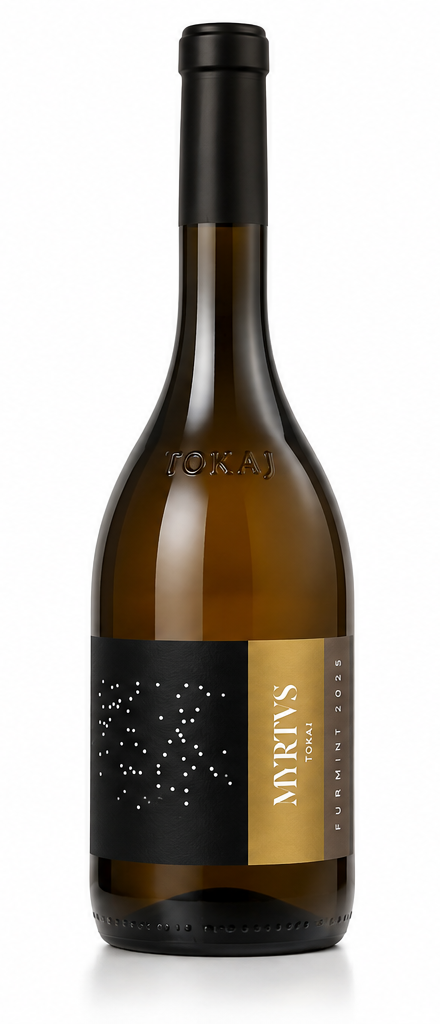


2025 Tokaji Furmint – Dry White Wine
PDO Dry White Wine
The 2025 Tokaji Furmint is a fresh, fruity, and mineral-driven dry white wine from Myrtus Winery, showcasing the unique terroir of Tarcal’s vineyards and the remarkable diversity of Furmint, Tokaj’s signature grape variety.
The vibrant character of the 2025 vintage is complemented by crisp acidity, citrus notes, and pleasant fruitiness. Elegant balance and a long, mineral finish complete this refreshing wine.
The Character of Tokaji Furmint
Furmint is the defining grape variety of the Tokaj wine region, renowned for its exceptional ability to express the distinctive characteristics of its terroir.
In the 2025 dry Furmint from Myrtus Winery, the mineral character of Tarcal’s vineyards meets the youthful freshness of the vintage. Lively fruit aromas, citrus notes, and vibrant acidity create a harmonious, approachable, and highly enjoyable wine.
This dry white wine from Tokaj is an excellent choice both for those discovering Furmint for the first time and for experienced wine lovers who appreciate expressive Tokaji wines with refreshing acidity.
Food Pairing Recommendations
Thanks to its freshness and well-defined acidity, the 2025 Tokaji Furmint is a versatile wine that pairs beautifully with a wide variety of dishes.
We particularly recommend it with:
- Grilled and roasted fish
- Poultry dishes, including chicken and turkey
- Light salads and vegetable-based dishes
- Seafood
- Relaxed gatherings with friends, or simply enjoyed on its own
Vineyard: Tarcal, Mestervölgy Vineyard
Vineyard area: 0.25 hectares
Year planted: 1986
Grape variety: Furmint
FHA NNKE
Contains sulphites
Mestervölgy Vineyard (Tarcal)
Historically, Mestervölgy was part of the renowned Mézesmál vineyard area. Its predecessor was the extensive Remete, or Nagyremete, vineyard in Tarcal, whose origins date back to the Middle Ages. Between 1476 and 1526, this vineyard belonged to the Pauline Monastery of the Virgin Mary in Tokaj.
The vineyard received its name from the Pauline Order, also known as the Order of Hermits. For a short period, the estate belonged to the Tokaj Castle domain. Later, following the rapid spread of Protestantism throughout the Tokaj-Hegyalja region, it became church property.
Mestervölgy was also closely connected to the history of a vineyard known as Tar Balázs (vinea Tar Balas), although historical vineyard records consistently identified it as part of Mestervölgy.
Balázs Tar, a prosperous wine merchant from Debrecen of minor noble origin, lived around the turn of the 15th and 16th centuries. In addition to his vineyards in the Szerémség region, he also owned vineyard estates in Tokaj-Hegyalja.
His name last appeared in historical documents in 1522, when he was recorded as owning vineyards in the Mézesmál area on the outskirts of Tarcal.
Following his death, shortly before the Battle of Mohács in 1526, his vineyard became part of the Tokaj Castle estate, which was then under the control of the Szapolyai family.
In 1540, the estate passed into Habsburg hands, and the Habsburg rulers granted the Tokaj domain to the Serédy family later that same year.
The name Tar Balázs Vineyard remained in use until the early 18th century. Between 1599 and 1711, the vineyard belonged to the Rákóczi family.
After this period, the name gradually disappeared from vineyard records, and the property was incorporated into Mestervölgy.
The First Historical Mention
The first clear and documented reference to Mestervölgy dates back to 1550.
Originally, the vineyard belonged to the Protestant schoolmasters of Tarcal, who at that time followed the Lutheran faith. These teachers were referred to in Latin as magister or magistri scholarum/scholae.
The name Mestervölgy, meaning “Master’s Valley,” originates from this historical connection.
An important religious synod took place in Tarcal in 1561, during which the Protestant communities of Tokaj-Hegyalja decided to adopt Calvinist principles instead of Lutheran teachings.
Until the beginning of the 17th century, Mestervölgy was primarily owned by Protestant church institutions and the local castle estate.
At the beginning of that century, Sigismund Rákóczi, who would later become Prince of Transylvania, purchased substantial vineyard holdings in Mestervölgy for his family.
By the middle of the 17th century, increasing numbers of noble families and townspeople had acquired vineyard properties in the area.
Many initially leased vineyards from the estate before purchasing them several years later.
Among the most prominent owners were the Kemény family, originally from Transylvania, as well as the Bónis, Gönczy, Hoper, Kovács, and Tokaji noble families.
In 1670, following the failure of the Wesselényi Conspiracy, the royal court confiscated vineyard properties in Mestervölgy.
These included vineyards associated with the noblemen Ferenc Bónis, András Gönczy, Mihály Kovács, and János Tokaji.
The vineyard belonging to the Reformed Protestant ministry was also confiscated.
These properties subsequently passed into the ownership of the Catholic parish of Tarcal and noble families loyal to the royal court.
In 1675, the court also seized the Kemény family’s vineyard holdings following the extinction of the family line.
During this period, historical documents occasionally distinguished three sections of Mestervölgy:
- Hosszú-Mestervölgy (Long Mestervölgy)
- Kis-Mestervölgy (Small Mestervölgy)
- Nagy-Mestervölgy (Great Mestervölgy)
However, these distinctions appeared only rarely in vineyard records.
2025 Tokaji Furmint – Dry White Wine
The Rákóczi Family
In 1699, members of the princely Rákóczi family divided their vineyard estates in the Tokaj-Hegyalja region.
As a result, part of Mestervölgy became the property of Julianna Rákóczi (1672–1717) and her husband, Count Ferdinand von Aspremont (1643–1708).
The remaining vineyards continued to belong to Francis II Rákóczi (1676–1735).
During Rákóczi’s War of Independence, in 1707, Prince Francis II Rákóczi instructed his estate administrator, Márton Krucsay, to compile an inventory of the vineyards around Tarcal.
At that time, the most significant vineyard owners in Mestervölgy included the following aristocratic and noble families:
Aszalay, Babócsay, Barkóczy, Bárczy, Bercsényi, Czimmermann, Ecsedy, Enyedy, Fáy, Gajáli, Gáspárdy, Haller, Isépy, Király, Lángh, Olcsváry, Püspöki, Rákóczi, Recsky, Sennyey, Széchy, Szentiványi, Szepessy, Tasnádi, Tárkányi, Tőrös, Trombitás, Váradi, Ványai, and Vécsey.
In 1711, following the suppression of Rákóczi’s War of Independence, the royal court confiscated vineyards belonging to the Bercsényi, Barkóczy, Olcsváry, Szepessy, and Tárkányi families.
Several years later, these properties were leased to other noble families.
During this period, the Komjáthy, Lónyay, Mudrány, Orczy, Ráday, Roxer/Rókusfaly, Szirmay, and Torday families acquired vineyard holdings in Mestervölgy.
The Jesuit monastery and college in Kassa (present-day Košice, Slovakia) also owned vineyards in the area.
By the middle of the 18th century, the Barkóczy family had regained its previously confiscated vineyards and once again became one of the largest landowners in Mestervölgy.
The Bárczy family’s vineyards had not been affected by the confiscations following the War of Independence.
Until the middle of the 20th century, the largest vineyard owners in Mestervölgy were the Barkóczy family and their descendants, together with the Reformed and Catholic Churches.
Two vineyard areas were historically separated from Mestervölgy: Nyavalya in 1615 and Hosszú in 1701. Both areas consisted predominantly of vineyards owned by aristocratic families.
2025 Tokaji Furmint – Dry
Myrtus Winery
Vineyard area: 3 hectares
Locations:
- Vigyorgó Vineyard, Tarcal
- Mestervölgy Vineyard, Tarcal
- Lestár Vineyard, Tarcal
- Betsek Vineyard, Mád
Grape varieties: Furmint, Hárslevelű, and Muscat
A bottle of wine is much more than a simple product that is filled, sealed, and sold.
It represents decades of dedication, experience, and craftsmanship.
It embodies the work of the winegrower who planted the vines, nurtured them to maturity, and carefully cultivated them year after year to provide the winemaker with the finest possible grapes.
It also reflects the knowledge and experience of the winemaker, who has spent years understanding the unique characteristics of each grape variety and vineyard.
By respecting the nature of the grapes and allowing them to express their full potential, the winemaker creates wines of exceptional character.
All this experience, dedication, and hard work come together in every bottle.
Our family vineyard, located at the foot of Tokaj’s iconic Kopasz Hill, was originally established by our parents.
In 2008, we took over the estate and founded Myrtus Winery. That same year, we produced our first wines.
Our winery is situated along the traditional wine cellar row in Tarcal, in the heart of the Tokaj wine region.
Our mission is to create elegant, beautifully balanced wines for everyone who appreciates the unique character of Tokaj.
Furmint – Tokaj’s Signature Grape Variety
Furmint is a traditional Hungarian white grape variety belonging to the grape family (Vitaceae) and the species Vitis vinifera.
It is associated with the Pontian-Balkan group of grape varieties and is regarded as one of Hungary’s most characteristic grapes.
Furmint is particularly renowned for its exceptional susceptibility to noble rot (Botrytis cinerea), making it one of the most important varieties used in the production of Tokaji Aszú.
The precise origins of Furmint remain uncertain.
Some theories suggest that the variety originated in southern Italy, while others trace its roots to the historic Szerémség wine region, located in parts of present-day Croatia and Serbia. Hungary itself is also considered a possible place of origin.
According to some linguists, the name “Furmint” entered Hungarian through French and ultimately derives from the Latin word frumentum, meaning “grain.”
One theory connects this name with the historical practice of drying grapes on straw to increase their sugar concentration before producing sweet wines.
Alternative names for Furmint include:
Zapfner, Szigeti, Som, Posipel, Moslavina Mosler, Furmint Bianco, Šipon, and Szalai.
2025 Tokaji Furmint – Dry White Wine
Myrtus Winery – Buy Tokaji Wine Online | Wine Delivery